
Formation and Classification of Baltic Dunes
The dune belt along Poland's Baltic coast formed as glacial meltwater deposited enormous quantities of sand in the coastal zone after the retreat of the Scandinavian ice sheet. Wave action reworked these deposits into beaches, and aeolian processes gradually built them into dune ridges. The result is a near-continuous sand dune strip extending from the German border near Świnoujście to the Vistula Delta and further east along Mierzeja Wiślana.
Polish coastal geomorphologists generally distinguish three dune types in this setting: embryo dunes at the upper beach, foredunes stabilised by marram grass (Ammophila arenaria), and older, inland dune ridges that carry mature pine and deciduous vegetation. In the Słowiński National Park area, a fourth category — active, unvegetated migrating dunes — occupies several kilometres near Łeba and at Czołpino.
The Łeba Moving Dunes
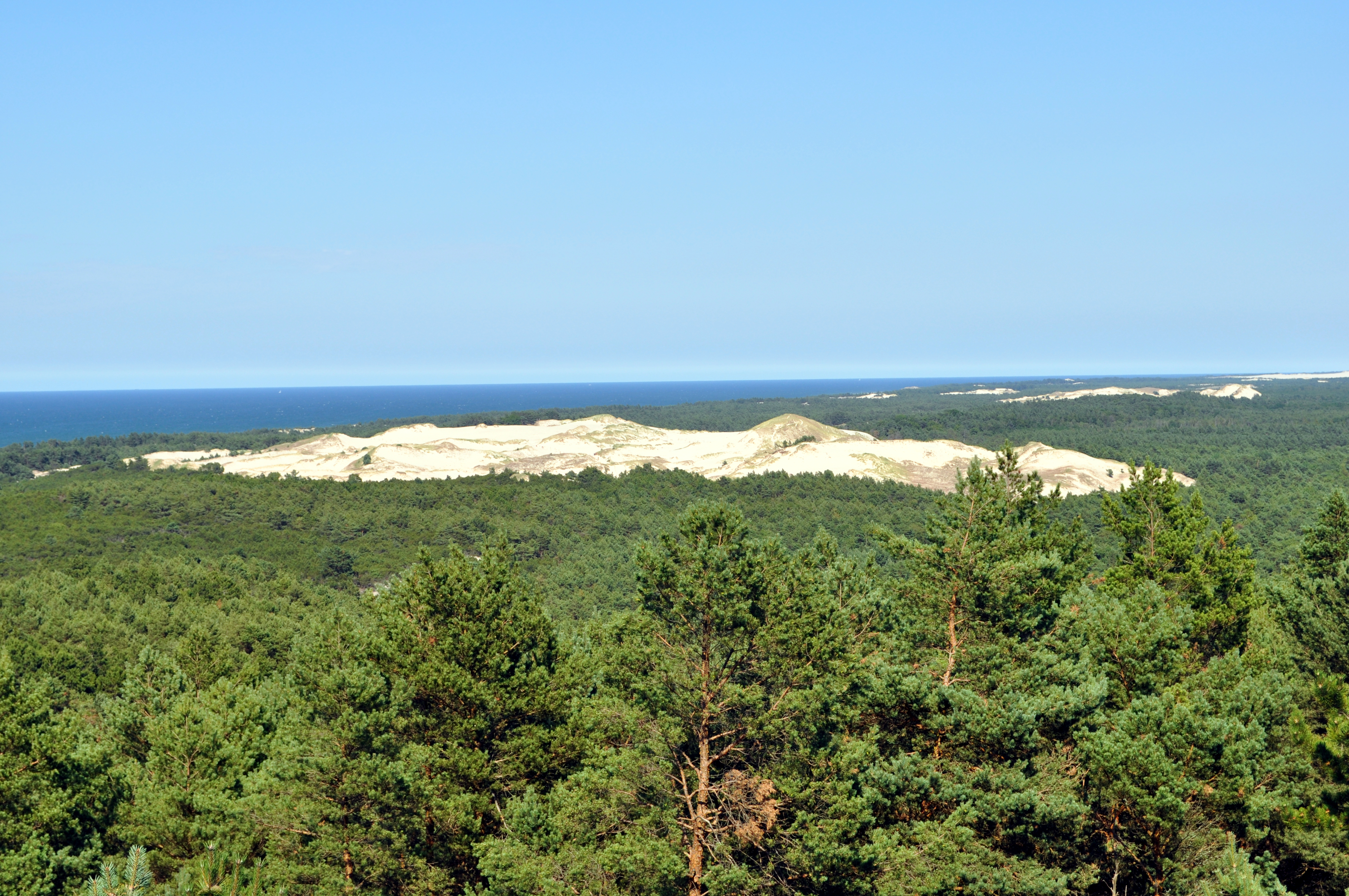
The Łeba moving dunes are among the most extensively studied aeolian landforms in central Europe. The largest dune body, known as Łącka Dune, extends several kilometres inland from the current shoreline and reaches heights above 40 metres in some areas. The dune migrates eastward, driven by the prevailing westerly and south-westerly winds that dominate this part of the southern Baltic coast.
The advance of the dune front has been documented since at least the 18th century and was the reason the village of Łeba was relocated westward at the end of that century. Historical records from local parish sources and Swedish cartographic surveys made during the early modern period provide the earliest dated evidence of the dune's movement. More recent measurements carried out by the University of Gdańsk and the Słowiński National Park authority used repeated topographic profiles and aerial photogrammetry to quantify the rate of advance, which varies considerably depending on wind conditions in a given year.
Vegetation and Dune Stabilisation
The transition from mobile to stabilised dune depends on colonisation by pioneer plants. On the Polish coast, marram grass is the dominant pioneer on foredunes. Its deep, branching root system binds the upper 30–50 cm of sand, while its erect stems trap aeolian sediment and promote dune accumulation. Sea lyme grass (Leymus arenarius) plays a secondary role in the same position.
Once marram grass establishes cover, other species follow: sea sandwort (Honckenya peploides), sea rocket (Cakile maritima) and, further inland, sea buckthorn (Hippophaë rhamnoides) scrub. The coastal pine forests that characterise much of the Polish shore — planted extensively in the 19th and 20th centuries specifically to halt dune migration — now form the dominant vegetation on most stabilised dune ridges between Mielno and Władysławowo.
Deliberate removal of marram grass cover, whether by trampling or vehicle access, can initiate blowout formation. Blowouts — bowl-shaped deflation hollows — are documented at several recreational beaches where footpaths breach the foredune. The Słowiński National Park management has installed wooden boardwalks at the most frequented access points specifically to prevent this.
Dunes on Mierzeja Wiślana
Mierzeja Wiślana (the Vistula Spit) runs for approximately 60 km along the southern shore of the Baltic, separating the Vistula Lagoon (Zalew Wiślany) from the open sea. Its dune ridge has been significantly modified by afforestation over the past two centuries, but active dune processes still occur near the Vistula outlets and at the eastern end of the spit, which lies in the Kaliningrad Oblast of Russia.
The construction of a canal through the spit, completed in 2022, altered local sediment transport patterns. Research published in Przegląd Geograficzny (the Polish Geographical Review) documented that the breakwaters flanking the canal entrance block longshore sediment movement, leading to accumulation on the updrift side and increased erosion downdrift. Dune development and beach width changes on either side of the canal were tracked using repeated cross-section surveys and remote sensing.
Sediment Budget and Aeolian Transport
The sand budget of coastal dune systems depends on the balance between supply from the beach and losses through inland transport or deflation. On the Polish coast, the primary sediment source is beach sand reworked from the nearshore bar system during onshore winds. After storm events that rebuild the beach face, fair-weather conditions with moderate winds allow aeolian transport from the upper beach to the foredune.
Measurements of aeolian sand flux on the Polish coast use sediment traps — vertical collectors positioned at different heights above the surface — and, increasingly, terrestrial laser scanning to detect small volumetric changes in dune morphology between surveys. Research at Rowy, documented in peer-reviewed literature, showed that shore protection works including geotextile tubes and artificial reefs altered the cross-shore sediment pathway in ways that had secondary effects on aeolian supply to the dune.
Key Locations for Dune Research on the Polish Coast
- Łeba – Łącka Dune (Łączka Dune), one of the largest active dune complexes in central Europe; Słowiński National Park
- Czołpino – active dune system near the Czołpino lighthouse; also within Słowiński NP
- Rowy – site of documented field experiments on shore protection and aeolian transport interaction
- Mierzeja Wiślana – long barrier spit with afforested dune ridges and dune changes near the Vistula canal
- Hel Peninsula (Mierzeja Helska) – narrow sand bar where dune integrity is critical to the structural stability of the peninsula itself
Conservation Status
The most ecologically significant dune areas on the Polish Baltic coast fall within protected areas. Słowiński National Park (Słowiński Park Narodowy), established in 1967 and designated a UNESCO Biosphere Reserve in 1977, covers the moving dune fields near Łeba and the associated lake and wetland systems. Access to the active dune surfaces is regulated, with designated viewing corridors to limit physical disturbance.
Additional protection is afforded through the Natura 2000 network. Several habitat types associated with Baltic coastal dunes — including embryonic shifting dunes (habitat code 2110), shifting dunes along the shoreline with marram grass (2120), and fixed dunes with herbaceous vegetation (2130) — are listed in Annex I of the EU Habitats Directive and are subject to conservation assessments across all EU member states including Poland.
References
- Słowiński National Park official documentation. slowinskipn.pl
- Rotnicka, J. et al. (2020). Impact of Sea Shore Protection on Aeolian Processes. Geosciences, 9(4), 179. mdpi.com
- Musielak, S., Łabuz, T., Osadczuk, A. (2012). Dynamics of the Polish Baltic Coast. Institute of Marine Sciences, Szczecin.
- European Environment Agency – Coastal habitats and dune types. eea.europa.eu
- Natura 2000 habitat descriptions – Annex I habitats. natura2000.eea.europa.eu